
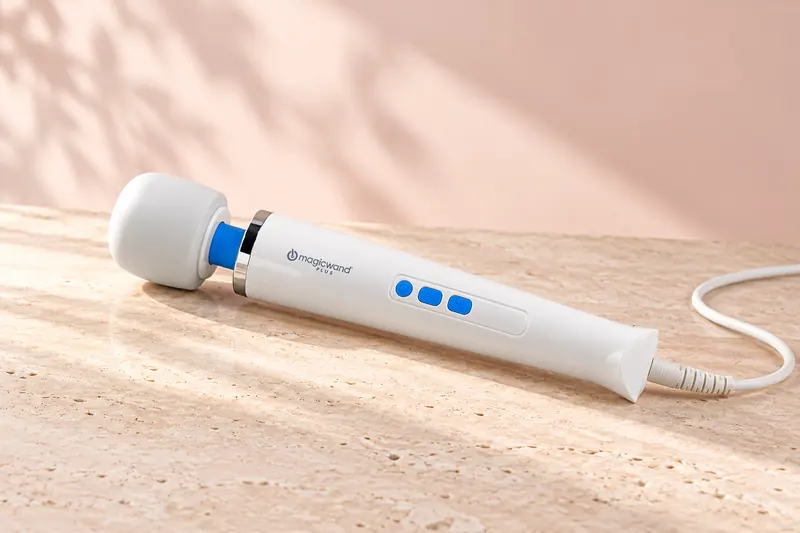
A corded vibrator plugs into a wall outlet instead of running on a battery, so the motor holds full power the whole session. This guide covers how to choose one, also called a plug-in vibrator, using published specifications, manufacturer guidance and buyer feedback.
We compared 8 corded wands on power, noise, heat and cord length. We considered published motor speeds, dimensions, care instructions and owner reports, rather than measurements from a bench test.
Below we explain what a corded vibrator is, its pros and cons, how we researched them, and which model fits your needs. We also compare prices and state plainly who should buy and who should skip. Our goal is a clear verdict, not marketing copy.
Key takeaways
- Constant power – corded models pull from the wall, so vibration never fades mid-session.
- Higher top speeds – plug-in vibrators reach 5,000–6,300 RPM, depending on the model; compare the maker's figures rather than assuming wall power always means greater intensity.
- Body-safe heads – favor non-porous silicone over porous TPR for easier sanitizing.
- Cord tradeoff – a 6-foot cord limits mobility and rules out travel.
- Best fit – these suit buyers who want heavy-duty, deep vibration at home.
What is a corded vibrator?
A corded vibrator is a vibrator that plugs into a wall outlet instead of using an internal battery. Because it draws constant power, the motor holds its top speed for as long as you run it.
A plug-in vibrator means the same thing, so the two names are interchangeable. Shoppers also call the strongest models a heavy duty vibrator or a powerful wand vibrator. Most corded models use the wand format, with a long handle and a rounded head for broad external contact.
The iconic Magic Wand line set the template for this category. In 2022 the Magic Wand Mini launched with three power levels up to 100 Hz (6,000 rpm), corded. That model shows the format has stayed consistent for decades.
The choice comes down to power versus convenience. A corded unit gives steady, deep output, while a cordless unit trades some intensity for portability. If you want the best corded vibrator for at-home use, prioritize motor speed and head material over travel features.
Wall power removes dependence on a battery charge, but it does not remove the need to follow maximum run times and automatic shut-off instructions. Check the manual for the specific model.
The wand shape matters as much as the power source. The long handle keeps your wrist neutral, and the wide head spreads vibration across a larger area than a slim bullet. That combination is why corded wands became the default for deep, broad stimulation.
This format suits home use where an outlet is always in reach. It works less well for anyone who wants a quiet, pocket-sized device. Match the tool to your setting before you weigh brands or price.
Pros & cons
The strengths and limits below come from the design, published specifications and buyer reports. We focus on the practical differences that matter for home use.
Pros
- Uninterrupted power – the motor never dims because it draws straight from the outlet.
- Higher top-end intensity – the classic corded Magic Wand provides two vibration rates, nominally 5,000 RPM on low and 6,000 RPM on high.
- Longer lifespan – there is no rechargeable battery to age, although motor life still depends on build quality and use.
- Lower yearly cost – you never replace a battery or pay for charging cycles.
- Deeper rumble – larger wand motors are designed for broad external vibration; feel varies by model.
Cons
- Tethered range – the 6-foot cord keeps you within reach of an outlet.
- Outlet dependence – no power source nearby means no session.
- Travel unfriendly – the cord and plug add bulk and block discreet packing.
- Louder operation – larger motors can be audible; compare published measurements and owner reports rather than assuming a wand is quiet.
- Heavier build – at about 1.2 lbs, these wands weigh more than most cordless models.
How we researched this
We compared 8 corded wands using manufacturer specifications, product manuals, retailer listings and buyer feedback. We checked motor speed claims, head material, controls, cord length and stated operating limits.
For heat and durability, we looked for automatic shut-off information, maximum run times and repeated owner concerns. We did not measure head temperature or run the wands through endurance trials.
RPM figures below are published motor ratings, not readings from our own tachometer. They do not describe vibration feel or comfort on their own.
For noise, compare independent sound measurements only when the setting and distance are disclosed. Buyer descriptions can flag a recurring rattle or loud motor, but they are not standardized decibel readings.
For cleaning, follow the manufacturer's instructions for the head and handle. Never submerge a corded wand; disconnect it from power before cleaning and dry it completely before reuse.
In-depth analysis & feature breakdown
Our scoring weighted four areas: materials, ergonomics, motor feel, and noise. We start with materials because body safety outranks every other feature.
The sections below break down what we found across the 8 units. Published figures are identified as specifications; noise, heat and grip are also factors to investigate in buyer feedback.
1. Design, ergonomics & material integrity
Material safety comes first. We favor non-porous silicone heads because they resist bacteria and sanitize easily, and platinum silicone is the simplest to clean.
Porous TPR heads cost less but trap residue and cannot be fully sanitized. Check the stated material and care limits rather than assuming every wand head can be sanitized in the same way.
Common wand specifications include a head diameter near 2.25 inches, a handle around 12 inches, and a weight of about 1.2 lbs. Cord length varies; check the exact listing rather than assuming every wand includes 6 feet.
A long handle can help with reach, but grip and comfortable weight depend on the user. The 2.25-inch head covered a broad area, which suits external use more than pinpoint contact.
Handle finish and weight affect grip. Compare the material, control placement and buyer comments about handling rather than assuming a glossy or heavier model will suit everyone.
Classic wands still use TPR heads, while newer plug-in models switched to silicone. If body safety is your priority, choose a silicone head and confirm the material on the label before buying.
2. Power, noise and operating limits
Motor feel splits into rumbly and buzzy. Rumbly vibration runs deep and low, while buzzy vibration stays on the surface. Compare buyer descriptions of the motor feel alongside the published speed range.
A modern plug-in wand reaches up to 6,300 RPM and automatically shuts off after about 20 minutes of continuous use. That shut-off limits overheating on long runs.
Noise varies by motor, setting and placement. A published decibel figure is only comparable when the test conditions are described; check owner feedback if discretion matters.
Follow the manufacturer's continuous-use limit and stop if the toy becomes uncomfortably hot. Automatic shut-off is a feature to check, not a reason to ignore the manual.
For durability, compare warranty terms and repeated buyer reports of rattles, damaged cords or inconsistent controls. We have not conducted long-term motor tests.
Several wands accepted silicone attachment caps that change the head shape. Check the cap's fit and material with the wand maker before using it. They also let you swap to a body-safe surface over an older TPR head.
Most corded units are not waterproof because the plug and cord break the seal. Keep them away from water and clean the head with a damp cloth only. Never submerge a plug-in vibrator.
Direct alternatives & competitor comparisons
Across the market, Spectrum Boutique's corded wand roundup shows prices range from about $69.95 to $279. The table below sorts the main options by price and best use.
Option | Price | Core feature | Best used for |
|---|---|---|---|
Classic corded wand | ~$70–$90 | 6,000 RPM top speed | Maximum deep power at home |
Modern silicone plug-in wand | ~$88 | Body-safe silicone head | Body-safety-first buyers |
Whisper-quiet plug-in oscillator | ~$224–$279 | Lower-noise operation | Discreet at-home use |
Rechargeable wand | ~$100–$150 | Cordless portability | Travel and cord-free use |
The classic corded wand wins on price and raw power but uses a TPR head. The silicone plug-in costs about $88 and fixes the material concern for close to the same money.
The plug-in oscillator costs more at $224–$279 but runs quieter for shared walls. A rechargeable wand gives up some intensity in exchange for cord-free use.
For most buyers, the approximately $88 silicone plug-in wand is worth comparing on value. Its published specifications combine a silicone head with high-speed output. It costs roughly a third of the oscillator.
Price does not track cleanly with power in this category. The $70 classic wand and the $88 silicone model both list high motor speeds. The gap between them is head material and control feel, not raw output.
For other formats and use cases, browse our vibrator reviews.
Final verdict & buying advice
Buy a corded vibrator if you want maximum power at home, deep rumble, and long durability. Check the published motor settings and continuous-use limit for the model you choose.
Choose a silicone head if body safety is your first concern, and follow the manufacturer's cleaning directions. Expect to pay around $88 for a modern silicone plug-in wand.
Skip it if you need travel-friendly, discreet, quiet, or waterproof gear. Compare cordless models on their own noise, waterproofing and battery specifications instead.
For a broader shortlist across styles, see our best vibrators overall guide.
Frequently asked questions
Which Magic Wand is better, corded or cordless?
The corded model holds a steady 6,000 RPM, while the cordless trades some power for portability. Choose corded for home intensity and cordless for travel.
Are corded vibrators waterproof?
Most are not, because the cord and plug break the waterproof seal. Clean the head with a damp cloth and keep the unit away from water.
How loud is a plug-in wand?
Noise varies by model and setting. Check published measurements with stated conditions and owner feedback about use in shared spaces; we have not measured these wands ourselves.
What material is safest?
Non-porous silicone is safest when the maker identifies it as suitable for the intended use and provides clear care instructions. Avoid porous TPR heads, which trap residue.
Can I use a corded vibrator with a voltage converter abroad?
Only if the converter matches the unit's voltage and wattage, since a mismatch can damage the motor. Check the label for 110V or 220V support before you travel.